The Science of Alignment
Iliad researches open questions in AI alignment before transformative AI arrives.
Apply to our FellowshipFellowships
We run the Iliad Fellowship to support researchers in pivoting their expertise towards alignment.
Community
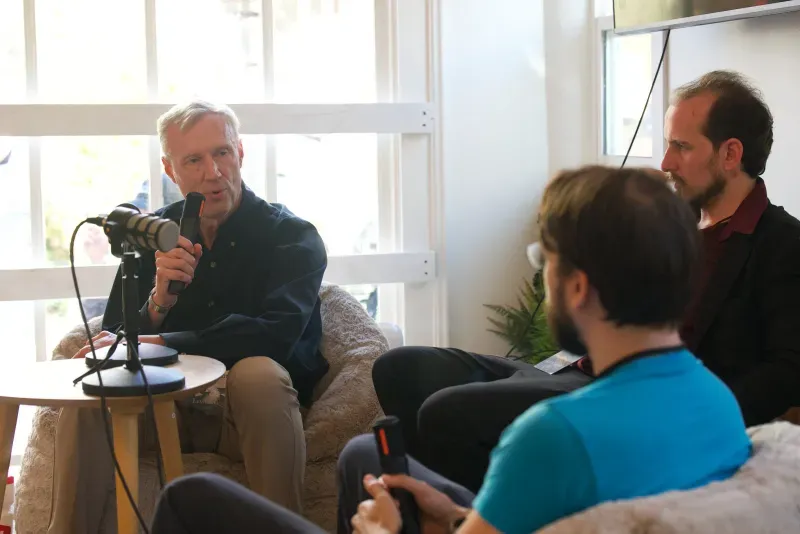
We host conferences and launched the first peer-reviewed Alignment Journal.
Upcoming events
The Iliad ecosystem
Explore the ecosystemOur lineage


Incubated at Iliad





Our research areas
Explore our researchLearning theory
Lead: Zach Furman
Alignment in practice consists of making interventions to the training setup (pretraining data, RL environments, etc), but this only affects the behavior of AI models through the training process. Studying how, when, and why capabilities emerge during the training process would better allow us to predict and control the behavior of AI systems.
Debate
Lead: Stephan Wäldchen
Alignment in practice has so far relied on RLHF to reward good behaviour. But how can a weaker human judge reliably evaluate a superintelligence? Prover-verifier games capture this for formal domains like mathematical proofs, and we aim to extend them to include statistical reasoning about the natural world. One promising approach is Debate, where two AI debaters recursively narrow their disagreement until it is simple enough for a human judge. We study when such protocols make honesty the unique equilibrium.
Heuristic arguments
Lead: George Robinson
Heuristic arguments are a technical approach to alignment that uses structure to reason deductively about properties of models without relying on sampling based methods. This area was pioneered by the Alignment Research Center, primarily through two conjectures: the Matching Sampling Principle, and the No Coincidence Principle. The Iliad Heuristic arguments group is working on understanding these principles theoretically in relation to other areas of mathematics and alignment theory, and experimentally in small concrete models.
Data attribution
Lead: Louis Jaburi
Models generalize during training. To understand and steer that process we would like to trace certain model behavior back to the training data. Which seemingly innocuous data points are actually malign? We develop methods that can answer this question in a reliable and tractable way. This requires understanding the training process and leveraging this knowledge to understand at what point capabilities are acquired and how we can influence that process.
Agency research
Leads: Daniel Chiang, Dalcy Ku, Satya Benson
We study how agents form concepts about the world, how they should pursue goals with limited computation, and how goal-directed behavior arises in physical systems. We assume only what should hold for any capable agent, including one that has redesigned itself, so our results don't depend on today's architectures. We want to understand what it would take for an AI system's goals to refer to what humans care about, and how we could check that a candidate system's goals would stay that way as it grows more capable. Current work includes mathematical theories of when different minds can share concepts, of which goals and beliefs survive self-modification, and of what makes a physical system an agent at all.
Geometry & structure of neural networks
Lead: Arturs Berzins
The Structure of Neural Networks group aims to advance learning theory and bridge it to interpretability. We want to deeply understand the space and organization of neural network solutions, how it is shaped by the data and the architecture, and what a learning algorithm selects. Our goal is to connect this geometric structure to safety-relevant observables and establish principled ways to control the selection of solutions.
Research Fellowship
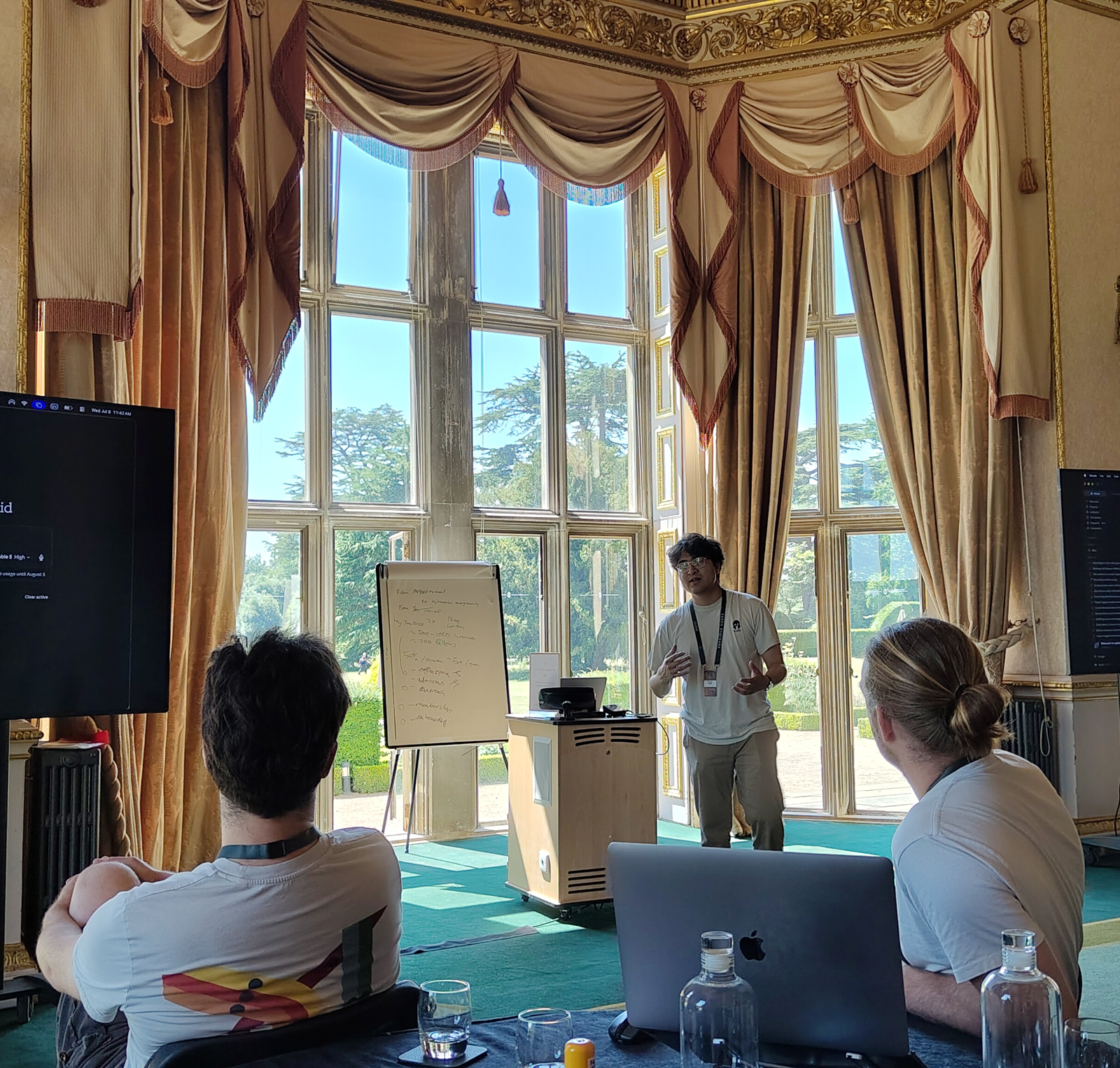
We run the Iliad Fellowship to enable scholars to pivot their backgrounds in technical disciplines towards research in AI alignment. Fellows must have completed the month-long Iliad Intensive. About half of our Fellows go on to receive a six-month research extension.
Talks from the Iliad Intensive
Learn more about the FellowshipThe Five Rules of Rationality Behind Reinforcement Learning
Fernando Rosas · XOR Labs
The Mathematics of Concepts: How AIs See The World
Satya Benson · Iliad
Deep Learning Is Singular - Here’s What That Means
Matthew Farrugia-Roberts · University of Oxford
The Dumbest Neural Network Worth Studying
Guillaume Corlouer · Stormglass
Uncovering the Hidden Biases of Deep Learning
Guillaume Corlouer · Stormglass
When Bad Goals ALSO Fit Your Training Data
David Quarel · ARENA
Community
Iliad hosts conferences and has launched the first peer-reviewed Alignment Journal to support collaboration across the field.
Join us